VR and AR in Education – Transforming How Students Learn
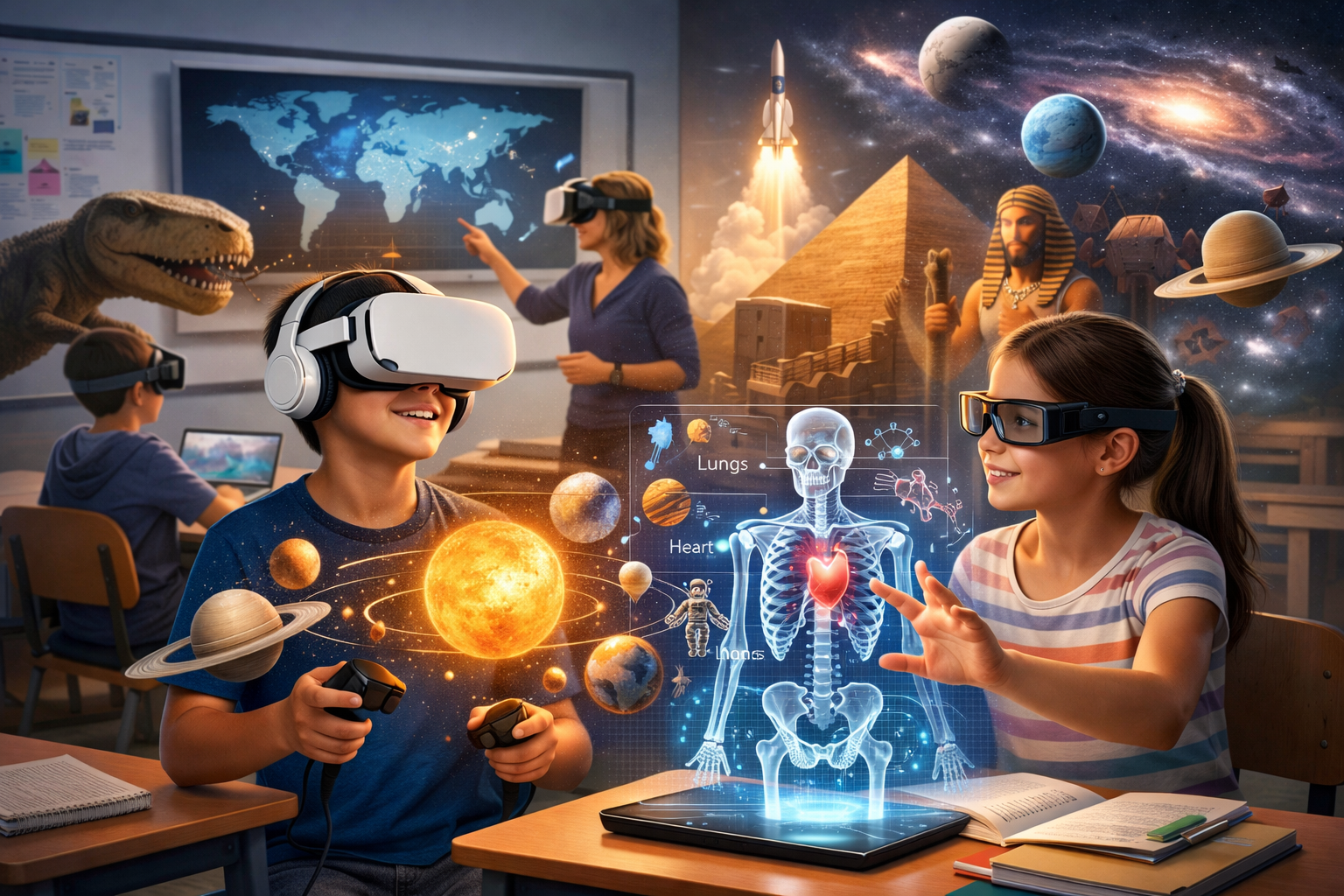
Imagine walking through ancient Rome while sitting in your classroom, performing a chemistry experiment without the risk of chemicals, or practicing a surgical procedure virtually before ever stepping into a real operating room. Virtual Reality (VR) education and Augmented Reality (AR) education are making these scenarios possible, redefining how students and professionals experience learning.
Traditional classrooms rely on lectures, textbooks, and static diagrams. While these methods have worked for decades, they often limit engagement and the ability to fully understand complex concepts. VR and AR in education overcome these barriers by creating immersive learning environments where students can explore, interact, and visualize information in ways that were never possible before.
What Is VR and AR in Education?
Virtual Reality education uses VR headsets to transport learners into fully digital environments. These simulations can include virtual laboratories, historical recreations, or interactive 3D models, allowing students to experience learning rather than just reading about it.
Augmented Reality classroom technology overlays digital content onto the real world using smartphones, tablets, or AR-enabled devices. For example, students can point their device at a biology textbook and see a 3D model of the human heart come to life, which they can rotate and examine from all angles.
By combining VR and AR, educational institutions create immersive education technology that enhances comprehension, engagement, and retention.
Benefits of VR and AR in Education
1. Increased Engagement
Immersive learning grabs students’ attention. Interactive VR simulations and AR activities encourage learners to participate actively instead of passively consuming information. This leads to higher motivation and curiosity in classrooms.
2. Practical, Safe Learning
VR classroom solutions allow students to practice real-world tasks in a risk-free environment. Medical students can perform surgical simulations, engineering students can test machinery operations, and science students can experiment without worrying about accidents.
3. Enhanced Understanding of Complex Concepts
Certain subjects, such as physics, biology, or history, are difficult to visualize through text alone. Examples of VR in education include exploring molecular structures in 3D or walking through historical landmarks virtually. AR learning tools for students make abstract concepts tangible and easier to understand.
4. Personalized Learning Experiences
With AI-powered VR and AR platforms, lessons can be tailored to each learner’s pace, style, and level. Students can revisit challenging topics or skip areas they already understand, improving efficiency and comprehension.
5. Better Knowledge Retention
Studies show that learners retain information longer when they engage actively with the content. VR and AR allow students to experience and interact with lessons, leading to deeper understanding and long-term retention
Real-World Applications
Medical Education
Medical schools are adopting VR education to teach anatomy and surgical techniques. Students can perform virtual surgeries, practice diagnostics, and learn procedures in a safe environment before treating real patients.
Engineering and Technical Training
VR simulations and AR classroom technology allow engineering students to interact with complex machinery, test designs, and explore 3D models, helping them develop skills without the cost and risk of physical labs.
Science Education
AR learning tools for students make science interactive. Students can observe chemical reactions, explore the human body, or manipulate molecular models in real time, improving understanding and engagement.
History and Cultural Studies
With VR, students can visit ancient civilizations, museums, and historical landmarks virtually. Immersive learning platforms bring history to life, making learning experiential and memorable.
Corporate Training
Companies are leveraging immersive learning platforms and VR classroom solutions for employee onboarding, skill development, and professional training. These tools save time, reduce training costs, and improve practical skill acquisition.
Challenges of VR and AR in Education
While the benefits are significant, there are challenges to adoption:
• Cost: VR headsets, AR devices, and software can be expensive for schools and institutions.
• Technical Requirements: High-speed internet, compatible devices, and technical support are needed.
• Content Development: Creating high-quality, interactive lessons requires expertise in design, programming, and pedagogy.
• User Adaptation: Teachers and students must learn to use the technology effectively for maximum benefit.
Despite these challenges, costs are decreasing, and platforms are becoming more user-friendly, making VR and AR more accessible than ever.
The Future of VR and AR in Education
The future of learning will be immersive, personalized, and global. Emerging technologies such as AI, 5G, and cloud computing will make VR and AR platforms more interactive, adaptive, and scalable.
Some expected trends include:
• Fully virtual classrooms connecting students worldwide
• AI-driven VR lessons that adapt in real time
• AR-enhanced textbooks and interactive course materials
• Immersive collaborative learning environments
These innovations will make education more engaging, efficient, and accessible for learners of all ages.
Conclusion
VR and AR in education are transforming learning by making it more interactive, practical, and immersive. From virtual labs to historical simulations, these technologies enhance engagement, understanding, and skill development for students and professionals alike.
As VR classroom solutions, AR learning software for schools, and immersive learning platforms become more widely adopted, the future of education will be more personalized, interactive, and ready for the digital age.
By integrating virtual classroom technology and interactive learning environments, educators can create experiences that were previously impossible, preparing learners for a rapidly evolving world.
.